
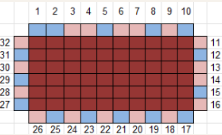
Rules as Preferences (Miss Manners Advanced). In the real world not all rules can be satisfied and we may consider them as preferences. For example, our June-2023 Challenge “Miss Manners” used a well-tuned data with equal numbers of males and females at each party. Of course, real data is not like this, but we still want to help Miss Manners to seat all guests while sticking to her rules as much as possible. So, the seating arrangement “boy-girl-boy-girl and each guest has someone on the left or right with a common hobby” becomes not a Rule but a Preference. New datasets for parties with 16, 32, 64, and 128 guests in this Excel file.
Implementation. This is a typical constraint satisfaction problem which could be easily represented and resolved by any Constraint Solver. Here is how this problem can be represented and solved using the latest OpenRules Rule Solver.
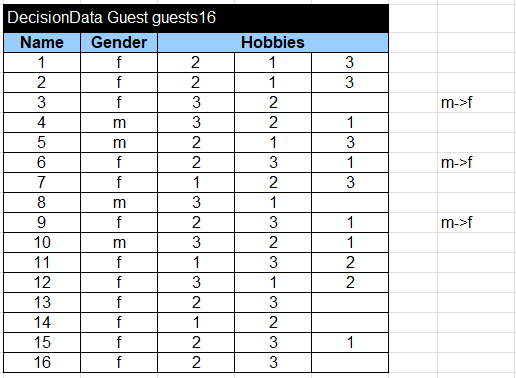
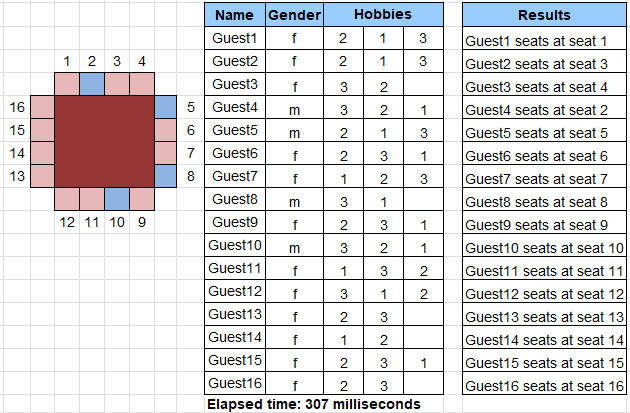
Problem Definition. Let’s start with the provided test data for the party of 16 guests converted to the OpenRules format in Excel file MissMannersPreferencesTest.xls:
Here is the corresponding business Glossary:
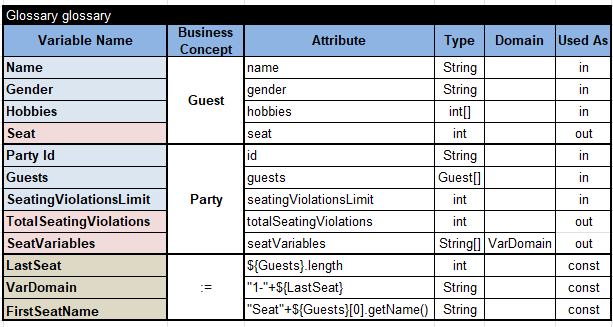
Thus, for each Guest we know Name, Gender, and Hobbies. Our goal is to define a Guest’s Seat for all Guests while satisfying as many Gender and Hobby rules (constraints) as possible.
We define all unknown variables in the array “SeatVariables,” each element of which is defined from 1 to the number of guests. We also added the output variable “TotalSeatingViolations”.
We will assume that seats are numbered from 1 to 16, 32, 64, or 128. The Last Seat is calculated in the above Glossary as the number of elements in the array of Guests.
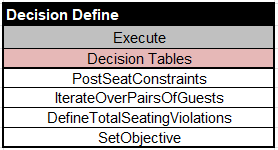
We will use the following top-level decision “Define” for the Problem Definition:
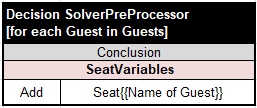
We will use the table “SolverPreProcessor,” which will specify the names of SeatVariables before even creating the proper decision variables with the name “Seat{{Name of Guest}}” and the domain VarDomain (see the glossary):
Then we post seat constraints:
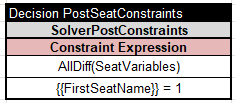
The first one states that all Seat Variables should take different values. The second constraint assumes that the first guest is always sitting at the first seat (as all other decisions will be simply symmetrical).
To post Gender and Hobby constraints, we need to consider all possible pairs of Guests (G1;G2) and state that G1 and G2 should have opposite genders and at least one common hobby. We can do it by executing incompatibility rules for each pair of different guests. We will use the predefined OpenRules “ActionNestedLoops” to iterate over different pairs of guests (G1;G2) inside the array of all “Guests”:
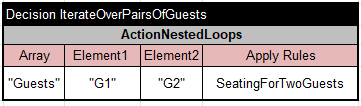
This iteration process will use several intermediate decision variables, which we may define in the following temporary glossary:
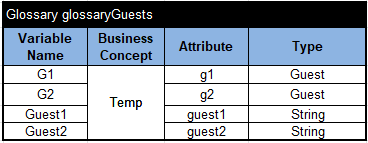
The decision “SeatingForTwoGuests” will be executed for each pair of guests (G1;G2), assigning temporary names Guest1 and Guest2 and executing the rules “CreateSeatingViolations”:
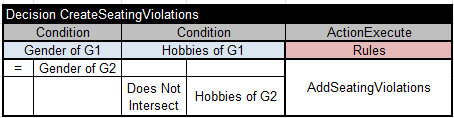
The table “AddSeating Violations” will be called if G1 and G2 have the same Gender (rule 1) or their Hobbies do not intersect (rule 2):
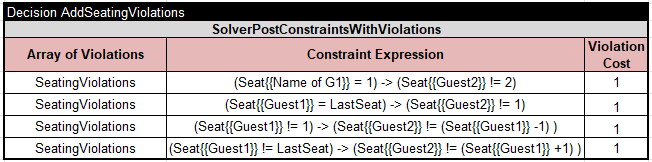
It uses the predefined column “SolverPostConstraintsWithViolations” to specify vaiolation constraints with their violation costs.
We also used the rules that remove possible symmetries to expedite the execution:

To complete the Problem Definition, we define “Total Seating Violations”, a constrained variable which we want to minimize:
Problem Resolution. We may rely on the predefined search strategy “SolverMinimize” defined in the main sub-decision “Solve”:
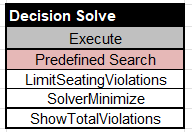
We may define the minimization objective as follows:
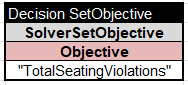
However, after doing experiments with this problem, we found that for large-sized problems like 128 guests, it is difficult for Rule Solver to prove in a reasonable time that it cannot find a better solution. So, we decided to limit the objective by posing the following constraint before the actual search:
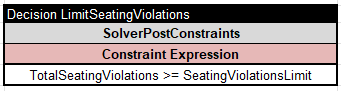
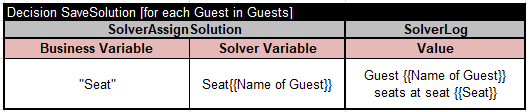
And after the search, we call the following table “SaveSolution” to assign the found solutions to all Guests’ decision variables Seat{{Name of Guest}} and to print the found solutions:
We may show the final total violations using this table:

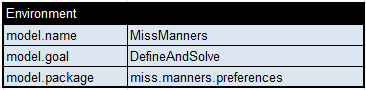
Main Decision. We may rely on the standard RuleSolver method “DefineAndSolver” to invoke both decisions “Define” and “Solve” as defined by the property “model.goal” in the Environment table:
Here is the automatically generated Decision Diagram:
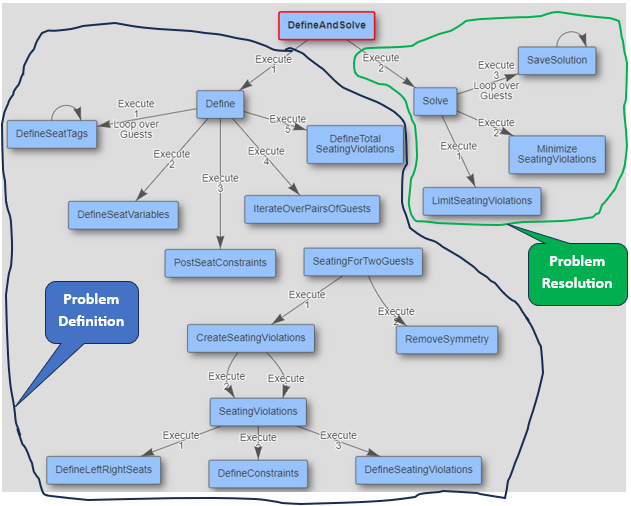
As you can see, all decision modeling efforts were on problem definition, and we don’t have to worry about problem resolution.
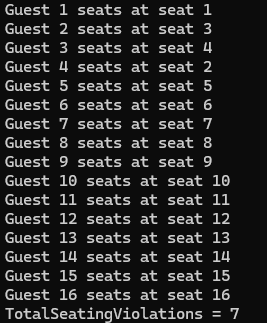
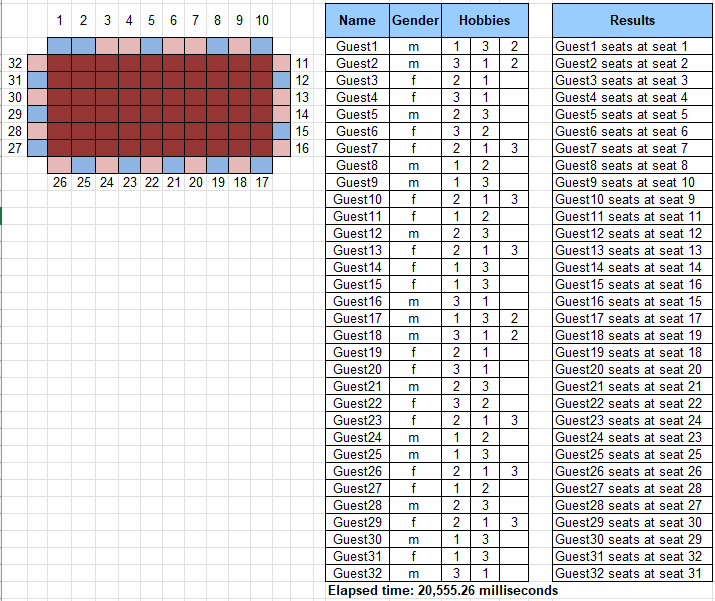
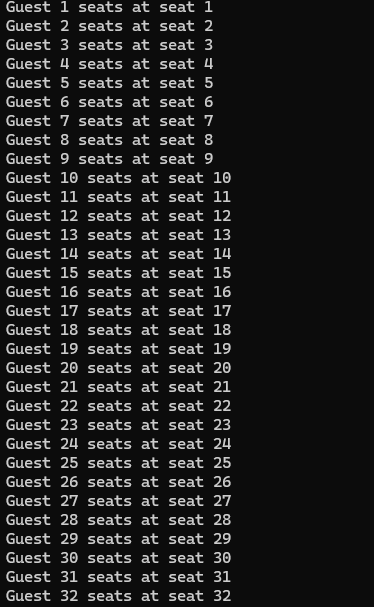
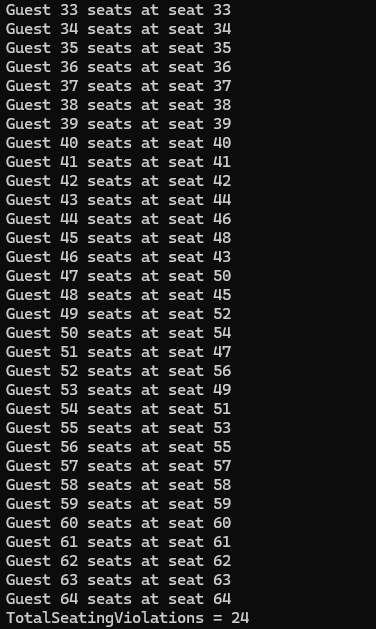
Execution Results. Running this decision model produced the following results:
Party of 16 Guests:
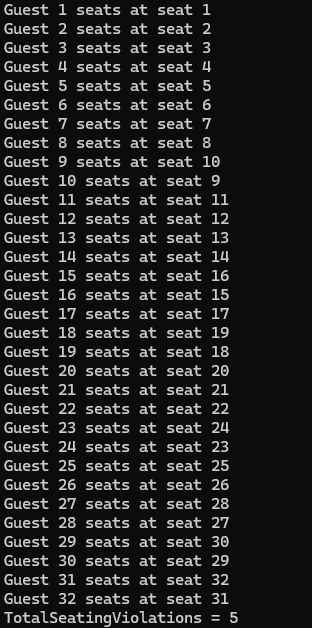
Party of 32 Guests:
Party of 64 Guests:
| 1 Seat[1] 2 Seat[2] 3 Seat[3] 4 Seat[5] 5 Seat[7] 6 Seat[9] 7 Seat[4] 8 Seat[11] 9 Seat[13] 10 Seat[15] 11 Seat[17] 12 Seat[6] 13 Seat[19] 14 Seat[21] 15 Seat[23] 16 Seat[8] 17 Seat[10] 18 Seat[25] 19 Seat[12] 20 Seat[14] 21 Seat[27] 22 Seat[29] | 23 Seat[16] 24 Seat[18] 25 Seat[20] 26 Seat[31] 27 Seat[22] 28 Seat[33] 29 Seat[24] 30 Seat[26] 31 Seat[35] 32 Seat[37] 33 Seat[39] 34 Seat[28] 35 Seat[30] 36 Seat[41] 37 Seat[43] 38 Seat[32] 39 Seat[45] 40 Seat[34] 41 Seat[47] 42 Seat[49] | 43 Seat[51] 44 Seat[53] 45 Seat[55] 46 Seat[36] 47 Seat[57] 48 Seat[38] 49 Seat[59] 50 Seat[61] 51 Seat[40] 52 Seat[63] 53 Seat[42] 54 Seat[44] 55 Seat[46] 56 Seat[48] 57 Seat[50] 58 Seat[52] 59 Seat[54] 60 Seat[56] 61 Seat[58] 62 Seat[60] 63 Seat[62] 64 Seat[64] |
Elapsed time 955.49 milliseconds
Party of 128 Guests:

| 1 Seat[1] 2 Seat[2] 3 Seat[4] 4 Seat[3] 5 Seat[5] 6 Seat[6] 7 Seat[8] 8 Seat[7] 9 Seat[9] 10 Seat[11] 11 Seat[13] 12 Seat[10] 13 Seat[12] 14 Seat[15] 15 Seat[17] 16 Seat[19] 17 Seat[21] 18 Seat[14] 19 Seat[23] 20 Seat[25] 21 Seat[27] | 22 Seat[29] 23 Seat[16] 24 Seat[18] 25 Seat[31] 26 Seat[33] 27 Seat[35] 28 Seat[20] 29 Seat[22] 30 Seat[37] 31 Seat[39] 32 Seat[24] 33 Seat[28] 34 Seat[41] 35 Seat[26] 36 Seat[43] 37 Seat[30] 38 Seat[32] 39 Seat[45] 40 Seat[47] 41 Seat[40] 42 Seat[49] 43 Seat[51] | 44 Seat[34] 45 Seat[53] 46 Seat[55] 47 Seat[57] 48 Seat[36] 49 Seat[59] 50 Seat[61] 51 Seat[63] 52 Seat[38] 53 Seat[42] 54 Seat[60] 55 Seat[65] 56 Seat[67] 57 Seat[44] 58 Seat[69] 59 Seat[46] 60 Seat[48] 61 Seat[71] 62 Seat[50] 63 Seat[52] 64 Seat[54] 65 Seat[73] | 66 Seat[56] 67 Seat[58] 68 Seat[75] 69 Seat[77] 70 Seat[62] 71 Seat[79] 72 Seat[81] 73 Seat[64] 74 Seat[66] 75 Seat[68] 76 Seat[70] 77 Seat[83] 78 Seat[85] 79 Seat[72] 80 Seat[87] 81 Seat[89] 82 Seat[91] 83 Seat[74] 84 Seat[93] 85 Seat[76] 86 Seat[95] 87 Seat[97] | 88 Seat[99] 89 Seat[78] 90 Seat[101] 91 Seat[80] 92 Seat[82] 93 Seat[84] 94 Seat[86] 95 Seat[88] 96 Seat[103] 97 Seat[90] 98 Seat[105] 99 Seat[98] 100 Seat[107] 101 Seat[92] 102 Seat[94] 103 Seat[109] 104 Seat[111] 105 Seat[96] 106 Seat[100] 107 Seat[102] 108 Seat[104] | 109 Seat[108] 110 Seat[113] 111 Seat[110] 112 Seat[106] 113 Seat[112] 114 Seat[115] 115 Seat[117] 116 Seat[119] 117 Seat[114] 118 Seat[116] 119 Seat[121] 120 Seat[123] 121 Seat[118] 122 Seat[125] 123 Seat[127] 124 Seat[120] 125 Seat[122] 126 Seat[124] 127 Seat[126] 128 Seat[128] |
Elapsed time 16,411.42 milliseconds

The proper standard project is available in openrules.solver/MissMannersPreferences.