
Rules and constraints complement one another. Rules express business logic in a familiar form, while constraints describe the relationships that every acceptable decision must satisfy. Together, they allow a single decision model to handle both ordinary business policies and complex optimization problems.
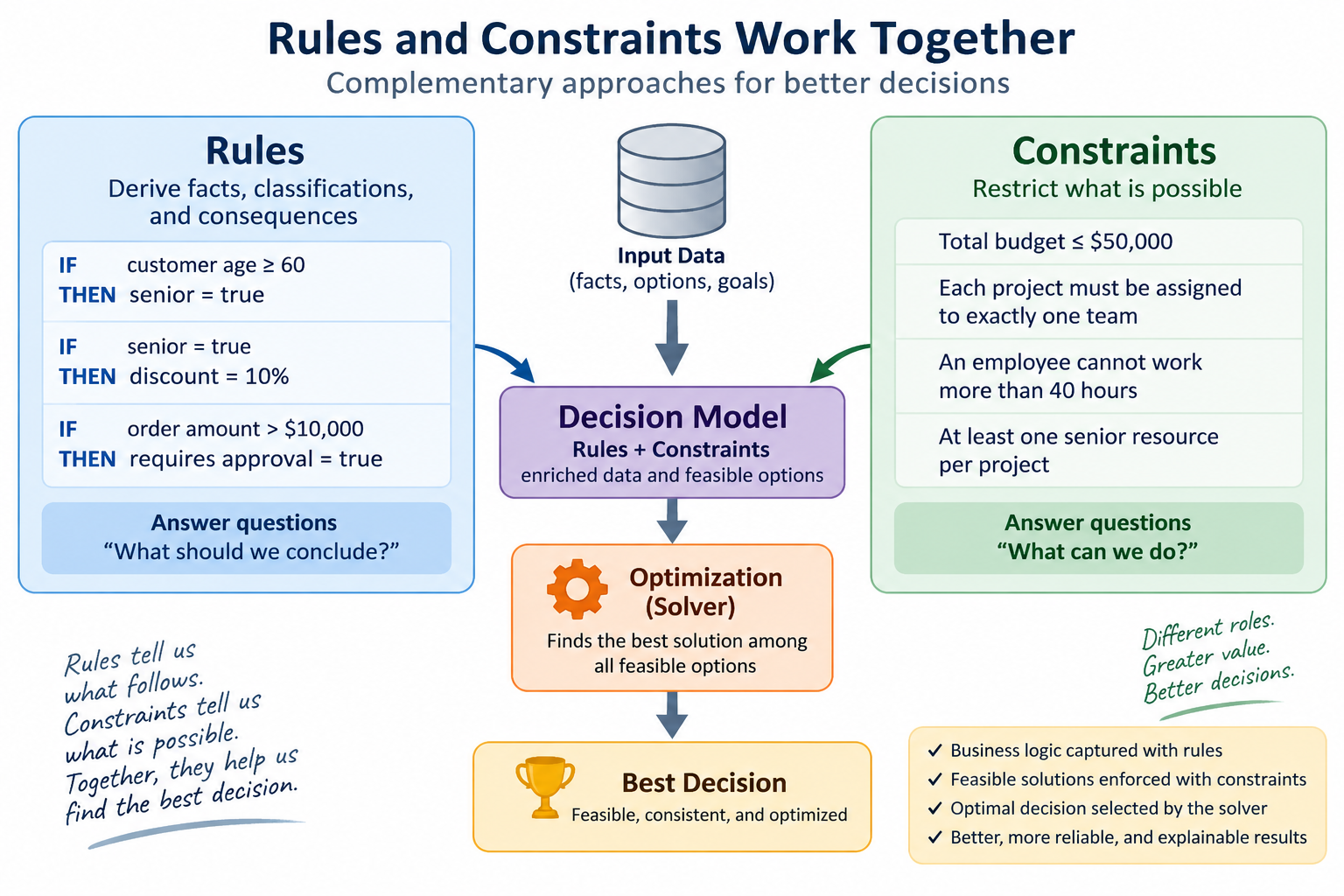
Different roles, one model
Rules are evaluated against known values and can derive new values immediately. Constraints remain active as relationships among decision variables, including variables whose values are not yet known. A solver can then search the remaining possibilities to find feasible or optimal decisions.
Better validation and resolution
Rules can validate and calculate business data, while constraint propagation can eliminate inconsistent possibilities early. This combination lets business users state what must be true without encoding every possible path to an answer.
Example: Where is Zebra?
The Zebra puzzle illustrates the difference. Its relationships can be captured directly in decision tables—for example, two values can be declared adjacent—while Rule Solver searches for a solution that satisfies all of the declared conditions. The result remains transparent, testable, and explainable.
Decision intelligence for business users
OpenRules integrates constrained decision variables, constraints, and objectives with traditional decision tables. Modelers retain the clarity of business rules while gaining the ability to produce multiple feasible answers or the best answer according to defined objectives.
Read the original Rules and Constraints Working Together article on DMCommunity.